
SEED SIZING GUIDE
Getting the plate size right
Proper plate sizing is critical to consistent planting rates and full yields. Seed is expensive — the right plate minimizes waste and skips. This guide will help you match your seed to the correct plate for John Deere and International Harvester style planters.
Not sure, or don’t see your seed listed? Send us a small sample — just 10–20 seeds, including the largest ones in the bag. Wrap them so they don’t get crushed by postage machines (a bubble mailer works well), and include your email address and the type of planter you have. We typically email back a plate recommendation the same day we receive the seed.
Once you’ve got the right plate, do a couple of rotations with the planter above ground on a flat surface (like a driveway) before you head to the field — it’s the easiest way to catch a spacing issue before it costs you a pass.
General guidelines that apply to every seed type
- Always size to your largest seed. If seed varies a lot in size, sizing to the largest avoids plugged cells and skips — you may get an occasional double of a smaller seed, but that beats skips.
- Aim for about 1/64″ of clearance around the seed in the cell. Much more than that risks a second seed fitting in alongside it.
- One seed per cell is standard — except soybeans, which are intentionally sized for multiple seeds per cell/drop to hit the right population.
- Thinner plates (Sunflower and Sorghum) need a specific filler ring to sit tight in the planter bottom. Skip the filler ring and seed can ride above or below the plate and drop out at random.
- Match filler ring thickness to the plate. The wrong filler ring for a given plate will throw off your seed drop even if the plate itself is correct.
- Replace worn plates as a set. An older, worn plate plants at a different rate than a new one — mixing worn and new plates across rows gives you inconsistent spacing row to row.
- Check the wear gauge. Most corn plates have a small hole on the bottom that becomes visible from the top as the plate wears down from seed contact — that’s your sign it’s time to replace.
- A worn planter bottom can matter too. If the bottom itself is worn, it leaves extra space around the plate that can let smaller seed through unevenly, independent of plate wear.
Corn
We stock about 15–20 different plate sizes for both round and flat corn seed. If your seed bag doesn’t list a specific plate recommendation, send us a sample and we’ll match it for you — seed that does carry a recommendation is generally graded more consistently for gravity-fed planters.
Round corn plates have a round or teardrop-shaped cell. Sizing comes down to two dimensions: the seed’s length and its width at the widest point. You want a plate whose cell is slightly longer and slightly deeper than your seed.
Flat corn plates have a rectangular cell and involve three dimensions — length, depth, and thickness:
- Length is the largest of the three, tip to tip.
- Depth is the smallest of the three dimensions and the most important one to get right — aim for a cell about 1/64″ deeper than your seed’s depth. The seed rides up on its skinny edge inside the cell.
- Thickness is how wide the seed is lying flat.
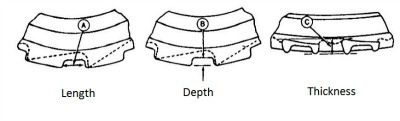
Once depth is right, double-check length and thickness fit the cell too. Most corn plates are 20/64″ thick, so plate/seed thickness is the least critical dimension — though some smaller flat corn plates run thinner than that. If your seed is wider than 20/64″, flip the floor plate that holds the plate in place: one side is flat, the other grooved, and the grooved side accommodates wider seed.
Sorghum (Milo)
Sorghum seed is labeled by thousands of seeds per pound, typically 10,000–20,000/lb, and that count maps directly to a specific plate size — one seed per cell.
- Single-drop sorghum plates are thinner than a standard corn plate and require a matching filler ring to sit tight in the bottom. Most come in 30 or 60 cells: a 60-cell plate typically plants 2–8 lbs/acre on 36″ rows, and a 30-cell plate plants about half that, depending on your sprocket settings.
- Multiple-drop sorghum plates are thicker, closer to a corn plate, and give multiple seeds per drop — these don’t need a filler ring.
See the specific plate list on our Store pages for which sorghum plate matches your seeds-per-pound.
Soybeans
We offer three plate sizes for both John Deere and International planters. All of our soybean plates are multiple-drop by design — you get several beans per cell, which is what gets you to the planting population soybean growers need. Because they’re multiple-drop, they work with any size of soybean seed. Most growers use the medium plate: B-Soy 2 (John Deere) or C-Soy 2 (International).
Sunflower
Sunflower seed is typically marked with a size code, #2 through #20, and that code correlates to a specific plate — one seed per cell.
- #2–#5 covers oil-type sunflower seed.
- #8–#20 covers confection (edible) sunflower seed.
Sunflower plates are thinner than a standard corn plate and need a matching filler ring. If your seed bag doesn’t list a size, send us a sample and we’ll recommend a plate — most seed dealers can also tell you the size if it’s missing from a smaller repackaged bag.
Sugar Beets
Sugar beet plates are sized to your seed’s diameter — make sure the seed fits the cell diameter with enough clearance against the plate’s thickness that it won’t crack.
Sugar beet plates require a dedicated sugar beet bottom, different from the standard corn bottom in most planters — it uses a specific metal floor plate, a metal filler ring with an integral drop tube, and its own sprocket setup. If you don’t have a sugar beet bottom, most growers instead use one of our single-drop sorghum plates with the required plastic filler ring on their standard corn bottom.
A note on filler rings for sugar beet plates: different plate thicknesses need different filler ring thicknesses, and it’s critical to get the combination right. Your planter’s owner’s manual is the best reference for which filler ring pairs with which plate — this is one spec we don’t maintain a master list for ourselves.
Massey Ferguson
We carry 4 plates for Massey Ferguson planters that use flat-drop cells (fully enclosed, roughly 8¼” overall diameter). If your MF planter uses edge-drop plates instead, ours won’t fit — check your planter’s plate style before ordering.
Other seed (vegetables, beans, etc.)
The recommendations below come from other customers’ experience, not from us testing every seed variety ourselves. Seed varies even within a variety, so always test-fit your seed in the cell and run a couple of above-ground rotations before planting.
- Beans (edible): Shapes and sizes vary widely — send us a sample. Plates growers have used before include B11-16, B11-24, B5-16, B5-24X, B13-16 and B13-24, often with the cell depth enlarged.
- Collard Greens: The largest single-drop sorghum plates (same as Okra) — B-Sorg 13-30 or B-Sorg 13-60 with a BFR-1 filler ring (JD), or C-Sorg 13-30/13-60 with a CFR-1 filler ring (IHC).
- Cucumber: Our smallest sunflower plate — B050-16, B050-24 or B-Blank 050 with a BFR-40 filler ring (JD), or C050-16, C050-24 or C-Blank 015 with a CFR-3 filler ring (IHC). Most growers get 2–3 seeds per cell with the existing cell size; some prefer a blank plate to set their own spacing.
- Okra: The largest single-drop sorghum plates — same as Collard Greens above.
- Peas: We size peas to a range of different plates — send us a sample and we’ll match one.
- Pumpkin: Most growers cut their own cells into a blank sunflower plate (B-Blank 015 + BFR-2 filler ring for JD, or C-Blank 015 + CFR-2 for IHC), typically 2–8 cells depending on desired spacing. See “Cutting Your Own Cells” in our FAQ.
- Squash: Our smallest sunflower plate, same as Cucumber above — the 16/24-cell versions need every cell enlarged to fit a squash seed, so many growers start from a blank plate instead.
- Watermelon: Same recommendation as Squash — smallest sunflower plate, cells enlarged, or start from blank.